By Alec Meer on November 15th, 2011 at 4:09 pm.

If there’s one feature that Steam really, really needs – other than an offline mode that actually works – it’s the ability to install games to someone other than the drive and folder Steam is plonked in. Perhaps there are complicated security justifications for not offering it, or perhaps everyone at Valve just has 48 terabyte hard drives. In either case, the trickle-down result for us everyday humans (I elevate myself to that category just for the sake of argument here) is that we can too often run out of space on our main drives and have to delete something existent in order to install something new. If you’ve been wise enough to invest in an SSD, your joy at rapid load times will be marred by your misery about its puny capacity limiting your Steamability. Salvation is at hand.
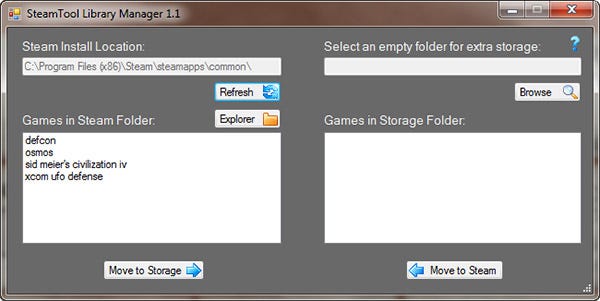
It’s a tiny third party program, as pointed out by reader KoldPT in comments – SteamTool Library Management uses clever but effective trickery to move games you don’t want on your main drive to another, and then fools Steam into thinking they’re where it wants them to be.
(Yes, I am entirely aware other ways of achieving the same effect exist, by the way – this one’s just easier and presents all your games as a neat little list to pick and choose from.)
N.B. there is a chance of things going wrong, as it’s all to do with virtual links which Windows might get confused about, so be sure to read all the guidance on the program’s site and backup anything super-important.


15/11/2011 at 16:11 Demacish says:
I’m sorry RPS but you were kinda slow whith this, this tool have been out for awhile
15/11/2011 at 16:12 Alec Meer says:
AMAZING
15/11/2011 at 16:13 arienette says:
You’re right, they shouldn’t've bothered at all!
15/11/2011 at 16:13 mollemannen says:
i didn’t know about it ^^
15/11/2011 at 16:14 Thomas says:
mklink /D c:\Steam x:\ is hard work.
15/11/2011 at 16:20 sneetch says:
That’s it! Close up the site, you were warned about posting “olds” instead of “news”, take down that banner, switch off that server, come on, lets go!
15/11/2011 at 16:26 Hoaxfish says:
I heard people at RPS eat cheese… that’s like old milk!
15/11/2011 at 17:41 Saldek says:
@Thomas: It wouldn’t achieve the same, though. You’d only be moving your entire Steam installation to another drive or partition. This method allows you to have your Steam content distributed over two drives or partitions. I’m sure many users wouldn’t want to fiddle around with manually symlinking that.
15/11/2011 at 17:56 Danarchist says:
I didn’t know about that either! And my SSD should arrive this week. This gets major luvs from me. I was really dreading the thought of having to waste drive lifespan with Puzzlequest2 when I really only want to play games that would benefit from the drives speed (e.g. Skyrim, Deus Ex, Borderlands, etc). Now I can split my turn based/old games onto my old drive and have the hew hawtness on my SSD :)
15/11/2011 at 20:17 Thomas says:
@Saldek
Actually it does, i was merely providing one amongst many examples on how to do it, heck you could even spread your various game across multiple drives and partitions, which the tool cannot “do”
I guess the tool actually uses the same symlinks, it just exposes a mildly less intimidating interface of doing so.
15/11/2011 at 20:24 Zealuu says:
It’s not that there’s anything wrong with telling people about this – because it, and SteamMover (which I’ve been using ever since I got my SSD) are both very handy tools worthy of media attention – but your wording here makes it sound like this was just invented yesterday.
16/11/2011 at 06:40 Avenger says:
Give it a rest. The post is useful.
I for one, did not know until this moment that such a tool existed.
Thanks to RPS, I can now seriously consider buying an SSD without wasting my kids’ hopes for going to college.
Thank you RPS!
16/11/2011 at 19:26 Saldek says:
@Thomas:
“Actually it does, i was merely providing one amongst many examples on how to do it, heck you could even spread your various game across multiple drives and partitions, [...]”
Your example wouldn’t, it would only move “your entire Steam installation to another drive or partition.”.
“[...] heck you could even spread your various game across multiple drives and partitions, which the tool cannot ‘do’ ”
Yes, it only “allows you to have your Steam content distributed over two drives or partitions.”.
“I guess the tool actually uses the same symlinks, it just exposes a mildly less intimidating interface of doing so.”
Though a totally viable option, mklink would need to be used for each folder you want to offload from the Steam partition, and “I’m sure many users wouldn’t want to fiddle around with manually symlinking that.”. I’m not trying to bash your method, as you pointed out it is more flexible. I just tried to point out that the GUI tool can do more than you can achieve by creating a single symlink.
16/11/2011 at 22:50 The Ninja Foodstuff formerly known as ASBO says:
@Demacish well dammit I clearly can’t use it now then! Curse you RPS, for making me aware of this useful application, now of all times!
15/11/2011 at 16:13 Vexing Vision says:
9 years of Steam, and they still haven’t figured it out…
Neat program. Me, I have three different Steam installations, each in a different partition.
15/11/2011 at 16:17 Gnoupi says:
True. You shouldn’t have to play with NTFS junctions, it should just allow you to put your games where you want, like Impulse, for example.
I assume it is easier for them in case of support, as you always know where the games are according to the Steam folder, but still.
15/11/2011 at 16:25 DanPryce says:
Is it really nine years? I look forward my my anniversary hat next year!
15/11/2011 at 17:55 exenter says:
It is 8 years.
15/11/2011 at 22:41 Werthead says:
8 years, 2 months and 3 days as of today (15 November). Though the overwhelming majority of people didn’t encounter it until Half-Life 2 came out a year and a bit later.
15/11/2011 at 16:15 StranaMente says:
I still crave for steam not to put its save game folders in my Documents folder. Why can’t you put it where I say, steam?
Why there must be this mess?
Is it you don’t like Windows 7?
Or it’s the games’ fault?
15/11/2011 at 16:18 Gnoupi says:
Because saves location is decided by the individual games.
The games which use Steam cloud for saves actually put the saves in the Steam folder. (somewhere in userdata)
15/11/2011 at 16:22 StranaMente says:
Damn you save game folders and game developers!
You are the reason why we can’t have an organized Documents folder.
(seriously I got 11 savegame folders clogging the folder I use the most in my pc, there must be a way out of here, right?)
15/11/2011 at 16:40 Gnoupi says:
Unfortunately there is no “norm” for game user files.
Some are in the game’s folder (although rare those days)
Some are in My Docs
Some are in My Docs/My Games (it’s not a norm, but a lot of them try to put them there)
Some are in %appdata%
With Steam Cloud, some are in one of Steam folders.
The main reason for using My Docs, or in general such user related folder, is that in case of a shared computer (gross, I know!), users can have their own settings and saves, for each.
15/11/2011 at 16:48 Shivoa says:
Because games are following (or ignoring) the MS policy for user game data or app data and over the years this has moved around a bit. Either way, the My Documents or other AppData type folders is a sensible default location for the non-technical as it creates a division of mutable and immutable files and without cloud syncing that is a rather handy split to create.
Why back up that 15GB of texture data I can grab from Steam at any point and is static, what I actually want is that 100MB of save games and my settings ini files to be checked daily and any changes saved somewhere safe. The split of files is designed to make that separation very clear so people can back up their mutable data only, and it doesn’t hurt for security policies where you may want the immutable data stored somewhere where the user’s default permissions do not allow editing of files (so only an elevation attack can rewrite the exe to inject nasties, for example). Of course, the exact advice changing and so the directory moving about hasn’t helped anyone but at least we’re not still running with most games using their local directory for any storage.
15/11/2011 at 16:55 StranaMente says:
Thinking of it, if I can’t move them, can I hid them? Will the games still find them?
I’ll try it…
15/11/2011 at 17:04 Shivoa says:
You can use the same trick this does to move them and let the game know where they are (because SymLinks are transparent, the program looking in a location never knows it even when through one and got redirected to the new location – this is why SymLinks are better than shortcuts, they are sneaky)
The only problem is visually you’ll have gained nothing as where once there was a folder you didn’t like the location of, now there will be a SymLink that looks like a folder (which the program follows) and the actual files will be wherever you linked it to go to. So you can have all your save files inside a single nested folder and kept snug together but you have to put in the place of the eyesores a SymLink that you’ll see (unless you make them hidden and have ‘show hidden files’ off in your GUI, but in that case just make the original folders hidden for the same cleaning up).
mklink /D C:\Link\Path\andName C:\Place\andName\ActuallyPointsAt
15/11/2011 at 19:03 LionsPhil says:
For what it’s worth, this is what is supposed to happen. There are good reasons for it, to do with separating stuff worth backing up and making sure everything works nicely on shared computers and security (there is no reason why a game should have to have permissions to write files all over the place willy-nilly).
15/11/2011 at 23:49 malkav11 says:
It’s still dreadful for people with several drives and/or partitions of various sizes. Sure, saves and whatnot may not be the biggest part of the install, but I’ve encountered games with saves ranging up to 100 MB a piece, and The Sims 2, for example, liked to chuck gigabytes of data onto the C: drive (usually my smallest as it’s not easily swapped out) without so much as a by your leave. Choosing a save directory, perhaps at install or as a menu option would be best, but if one must automatically assign a location, in the game directory ensures that it’s with the rest of the game data that I presumably chose to place where it is for a reason.
It continues to drive me batty that on PC, where I want to choose this stuff, I’m never asked, but on Xbox 360, where I have one hard drive which I always, always want to use for saves, I am asked where to save with extreme regularity. -sigh-
16/11/2011 at 09:28 olemars says:
The Witcher is horrid on save game sizes. Each save is several tens of MB, and with the default autosave EVERYTHING policy, the save folder was in the several GB range by the time I caught on.
15/11/2011 at 16:16 roethle says:
This is the reason I have not upgraded to a solid state hard drive. Damn steam folder is over a terabyte.
15/11/2011 at 17:08 ulix says:
I just use a 60 Gig SSD for Windows and applications like Firefox, Windamp, Miranda and so forth, and have a 1TB “traditional” harddrive for my games. Where Steam is installed on.
15/11/2011 at 17:45 jonfitt says:
You’ve been missing out. SSDs are wondrous.
Even if this weren’t possible, just archiving all the games that you’re not playing and having a couple installed at a time is worth it.
16/11/2011 at 01:37 V. Profane says:
I’ve got a 120gb SSD with Windows 7, Office 10 etc and I’ve currently got Fifa 10, Witcher 2, Borderlands, Ass Creed, Portal and more installed, and I’ve still got 26gb left. How many games do you need installed at once for fucks sakes?
16/11/2011 at 07:06 MattM says:
All, I need all the games installed.
16/11/2011 at 08:34 DavidHewlett says:
The solution is fairly simple, though might be mildly expensive:
Buy an Intel Z68 motherboard (and compatible CPU if necessary)
Buy any 60GB SSD (I’m personally a great fan of Corsair Force GT’s for this exact purpose)
Install these combined with your current, large, classic HDD
Install Intel SRT
Set the 60GB SSD as cache for the large classic HDD
I don’t know exactly how, but this allows your PC to recognize which files are the most important ones for fast boots and program start-ups. After about 4 restarts of any program it should be running as fast as it was actually installed on an SSD
15/11/2011 at 16:16 Boothie says:
thank you rps for letting us know about this, i was debating wether to get an ssd at all since the it would limit me on steam, now im getting 2 =D
15/11/2011 at 16:18 SquareWheel says:
I’ve been using symbolic links for years and that’s been fine. Is there some advantage to using this tool?
15/11/2011 at 16:21 Gnoupi says:
This is a simple GUI to create junctions, not symbolic links. So there might be some minor differences, but it should be mostly the same.
15/11/2011 at 16:57 Shivoa says:
Keep on using Symbolic Links (unless you’re having to run in a WinXP/2k environment for some reason) as every time a Win V/7 user creates a Junction Point, a backward-compatibility legacy demon gains its horns.
For those not aware, “mklink /D” is the command you want, “mklink /J” is an abomination (or a legacy option, as they are also known). Symbolic Links (/d) were added to Vista/7 to get round some shortcomings of the NTFS Junction Point (/j) and so the ability to create them is only there for those who need the ability to make links compatible with XP/2k, it was not designed to be used for general linking (otherwise they wouldn’t have gone to all the bother to replace JPs with a better method of creating transparent link).
15/11/2011 at 16:18 Sheza says:
This has been available in the form “Steam Mover” for quite some time. Very useful for SSD users.
15/11/2011 at 17:12 Arrakiv says:
As a prospective SSD buyer who has never heard of this program, I for one am quite happy to hear about it now. More so since it looks like you can easily move games in and out of the main steam games folder, which is exactly what I was looking for.
… Desire to spend money on an SSD rising…
15/11/2011 at 20:00 Saarlaender39 says:
I double this…
I used this program
http://www.traynier.com/software/steammover
just last week to move all my installed steam-games from c:/ to my external harddisk
It was absolutely necessary, `cos c:/ was almost full.
Good program, but depending on how many games you have to move, be patient…it takes a lot of times!
15/11/2011 at 16:19 SlyDave says:
I have been using Link Shell Extension for the last forever, to do this: http://schinagl.priv.at/nt/hardlinkshellext/hardlinkshellext.html
On Windows Vista and Windows 7 it allows the creation of Junctions (basically the windows equivalent of symlinks)
The good thing about the Link Shell Extension it just that, it’s an Extension to the Shell… Move a folder to a new drive, then drag the folder back to the steam directory and then select create Junction – job done – Steam has no idea it’s in another location.
This is really great for installing Shogun Total War 2 onto an SSD just so you don’t have to wait 10 mins to play a 5 min battle.
And it works for anything, not just Steam. you can physically move your collection of music/videos etc to other locations but retain the folders in their original place – thus not fragmenting your collection.
15/11/2011 at 16:20 Lord Custard Smingleigh says:
I, for one, welcome our new Steam-folder-moving overlords.
15/11/2011 at 16:21 reggiep says:
A nice utility for sure, but people “in the know” have been using mklink to solve this issue for some time now. Creating symlinks to free up space on an SSD for Steam is not the only thing that symlinks are useful for. You can use them to do clever things with Dropbox as well — such as syncing your Firefox profile to multiple computers.
15/11/2011 at 18:13 phuzz says:
(You know firefox now has a sync tool built in? It works quite well.)
15/11/2011 at 16:23 Deadly Habit says:
well i didn’t know about this, so thanks for the heads up since my steam partition is almost full!
15/11/2011 at 16:31 DickSocrates says:
While Steam should allow games in different drives, may I ask why anyone has so many different games installed at the same time? Take a good look at your Steam list and realise that 99% of the games on there you haven’t even thought about, let alone tried to play in over 3 or 4 years. I only ever have the two or three games I’m currently ‘in’ to installed. I can understand that position plus a few possibles, but not every single game.
15/11/2011 at 18:44 LavaMonkey says:
For me it’s my terribly slow netspeed, so it’s easier for me to just keep everything installed all the time.
15/11/2011 at 22:35 protospork says:
Yes, network speed– and caps. If I was to decide at a whim that I wanted to play GRID, but it wasn’t installed, I’d have to stay up until 2am to start the (enormous) download without it affecting my (pitiful) bandwidth allowance.
16/11/2011 at 01:40 V. Profane says:
Why not use the backup feature and put them on DVDs or a separate drive?
16/11/2011 at 11:37 Wandering Taoist says:
You might need to update it after restoring backup, which again sometimes means several hundred MB of download. I leave most of my games on external drive (through Steam Mover) – they are fully updated and ready to play whenever I decide to play them. My gaming time is scarce (two kids do that), so having this option is very convenient.
26/11/2011 at 08:14 wengart says:
Yea, net speed is my issue. At uni I get 1 meg speeds easy while at home I have 200 mb daily caps to worry about (rural US internet sucks) so I need to have all 160 games downloaded.
15/11/2011 at 16:31 shoptroll says:
Thanks for linking to this! I heard it was possible to do this manually, but this looks like a nifty solution. Bookmarking for when I take the plunge on a SSD soon.
15/11/2011 at 16:31 akaleus says:
Periodically, I have to go through my whole steam library to see what games I’m not playing and delete them or just use the steam backup function to save them to my backup drive ( this works rather nicely ). I can usually find enough space to fit my next game that way.
15/11/2011 at 17:38 jonfitt says:
Yes. Since upgrading to an SSD I have taken to using backup/restore for moving games onto a large HDD for “storage”.
This would have some benefits since Steam would still keep the games up to date. I recently restored Men At War to discover that it needed a large update before I could play it.
15/11/2011 at 16:35 deadly.by.design says:
As someone looking to get a SSD in the near future, I’d like to thank RPS for bringing this issue (and solution!) to my attention.
15/11/2011 at 16:35 Kdansky says:
Or you know, you could just learn to use this simple one-liner:
http://technet.microsoft.com/en-us/library/cc753194(WS.10).aspx
mklink -j Skyrim G:/SteamStuffSkyrim
15/11/2011 at 17:09 Shivoa says:
Please use -d, unless you are on WinXP or dual-boot into WinXP and require the links to work there.
-j is a legacy option, Win V/7 has proper SymLinks.
15/11/2011 at 16:37 Azhrarn says:
I simply installed Steam to one of my large storage drives. It happens to be a nice and quick model too (a 1TB Samsung SpinPoint F1 to be precise, fastest in its class back when I bought them), as such I haven’t really had issues with Steam’s fairly archaic system, but this tool certainly looks handy for those who have Steam on a small drive or want to put a specific game on a faster drive such as an SSD.
15/11/2011 at 16:40 jplayer01 says:
If they just put all the saved games in the “My Games” folder under My Documents, so that I don’t have a dozen (and more) company-named folders clogging up my view (but still have quick access to the files in case I need it), it would be fine. But the way things are now, I’ve resorted to creating my own “Documents” folder where I put all my actual stuff and can organize it how I want it.
Edit: Whoops, this was meant as a reply to a post further up.
15/11/2011 at 16:40 parlinotomte says:
It’s quite easy even without a GUI tool: https://support.steampowered.com/kb_article.php?ref=7710-tdlc-0426
15/11/2011 at 16:47 Jake says:
I gave up trying to keep my current games on my SSD and now just put everything on a second HDD. Maybe if I ever found a game I played for a long amount of time that had excessive loading times I would make some space on my SSD, otherwise it just doesn’t seem worth the hassle of moving it around later.
I am curious which games in particular benefit from an SSD as I’ve never really found any where the loading time is such a drag: I don’t really notice a difference now that I’m not using my SSD for gaming any more.
15/11/2011 at 16:50 sneetch says:
Yeah my SSD is pretty much for the OS only now, I bought a fairly cheap Samsung 2TB SATA2 drive that I use for all my games and I haven’t noticed any problems with load speeds.
15/11/2011 at 18:55 Jake says:
I am sure there must be some games that it makes a big difference to because a lot of people clearly love their SSDs but it just doesn’t match my experience at all. I am certain the time I spent copying files from one HDD to another was far longer and more annoying than time I saved loading up games. Maybe I am just not very observant.
16/11/2011 at 20:54 grundus says:
I’m hoping Rage will benefit from this. To be fair, between having the texture cache set to large and the fact that I have a P8Z68-V which lets you use free space on the SSD as a cache, I haven’t seen a lot of that texture pop-in that was all the ‘Rage’ back when it was released, but maybe if I move it to my SSD I’ll see literally none of it, not even when the texture first loads.
I doubt it (but only because it’s already really, really fast).
Also I’m really sorry about the pun.
15/11/2011 at 16:51 Beelzebud says:
I just fire up the command line and use “mklink /J” to make junctions.
15/11/2011 at 16:55 andrewi31 says:
Thanks, this is good news.
Regarding the offline mode, it’s much less flaky than it has been in years past. At least for me and I’m offline quite a bit. There is still an issue if you don’t set it in offline mode beforehand AND Steam’s client needs updating, your screwed. I still prefer GamersGate for this reason (plus honestly I’d rather support a Swedish distributor), but I have had considerably less issues with Steam’s offline mode than I used to.
15/11/2011 at 17:10 mbp says:
+1 on two counts (should that be +2?)
1. For pointing out this useful tool. This really is a facility that Valve should provide themselves. I have no idea of the logic behind Steams filing system. Some games are stored under users. More are stored under common. Its a mess.
2. For remembering to poke fun at Steam’s offline mode. In my experience Steam’s offline mode works great as long as you have a working internet connection. Once you remove yourself from the internet (ie when you actually want an offline mode) it is liable to go into a huff and refuse to load.
15/11/2011 at 17:31 JagRoss says:
This one was featured on lifehacker.
http://www.traynier.com/software/steammover
15/11/2011 at 18:06 sneetch says:
Edit: Ooh, never mind, my mistake.
15/11/2011 at 18:00 yxxxx says:
I have been using game save manager to do this
http://www.gamesave-manager.com/
Means i can have my most played games on my ssd and i can also back up my saves should somehting go wrong,
16/11/2011 at 03:34 Anach says:
Was going to say the same thing. Primarily I use it for backups, but the Steam Spreader feature is very handy.
15/11/2011 at 18:23 Was Neurotic says:
YYYYYYYYYYYYYYYYEEEEEEEEEEEEEEEEEEEEEESSSSSSSSSSSSSSSSSSSSSSSSSSS!!!!!!!!!!!!!!!!!!!!!!!!!!!!!!!!!!!!!!!!!!!!!!!!!!!!!!!!!! I’ve been longing for this for years. Now if only they wouldn’t IP-block my purchases becasue they think I’m a Ukrainian terrorist with stolen UK bank details, I might actually fucking buy some more games from them.
15/11/2011 at 19:16 propjoe says:
Do all of you keep all of your Steam games installed at all times? That’s… interesting. I guess it would make sense if you had dial up or something. I don’t know.
My concern is that I’m super, super paranoid about pissing Valve off and getting my account deleted. Because, you know, that’s where all my games are. Are we 100% sure that this doesn’t violate the User Agreement? I mean, even though it clearly shouldn’t?
15/11/2011 at 20:36 Navagon says:
Thanks, guys! Steam really does need to do something like this itself.
15/11/2011 at 20:59 unexpectedpanda says:
I’ve also created a tool to help overcome one of Steam’s weaknesses: forgetting the auto-update settings.
Sadly it does force update back on for individual games whenever you launch them. Vexing.
15/11/2011 at 21:03 unexpectedpanda says:
-Edit- Double post.
15/11/2011 at 21:06 InternetBatman says:
I haven’t had any problems with the offline mode, but that’s just me. Personally I think they really need three features, one is a way to directly browse all of the games from the front page. Right now you have to go through a couple sets. Another is the ability to tag games instead of do categories. The third is to have the client remember your age. I’m tired of having to put it in any time I want to look at a mature game.
16/11/2011 at 13:36 Thermal Ions says:
I’ve found that recently the age gates within the Steam client started being remembered. I haven’t had to reset my DOB to 1 Jan 1901 each time for a good month or so.
15/11/2011 at 21:35 Demiath says:
I have an SSD drive for my operative system but I never install any games on it (I’m quite happy with the load times as it is). Tech isn’t my strong suit, but I thought constantly moving and deleting data onto an SSD drive wasn’t such a great idea (in the long run) compared to conventional drives?
15/11/2011 at 22:13 Sigvatr says:
I’ve never mentioned it before, but any time I install a new Steam game, I have to delete another game from my hard drive.
16/11/2011 at 20:59 grundus says:
So did I until I got a 2TB drive for pretty cheap. Now I have 131 games installed and I don’t think I’m even breaking 1TB, so that’s nice. To those who say you could just keep deleting games you’re not playing, how can you call yourself gamers? If I had to do a 7GB download (which takes over 7 hours with my connection) every time I wanted to play, say, the majority of games that exist, I’d only ever play what I have installed. I value the fact that I have all my games right there in front of me, but I suppose I do have a pretty slow connection.
15/11/2011 at 22:42 Angryinternetman says:
I dont mind my games going all in the same drive, but ALL the save games go to C: ! I havent got a byte to spare in C: !
16/11/2011 at 13:42 Llewyn says:
No, all the games go on the drive where the Steam client is installed. There are easy to follow instructions on how to move this on the Steam help pages.
15/11/2011 at 23:41 Tams80 says:
Why did I have a feeling this would be an article?
16/11/2011 at 02:23 tehfish says:
Nice to see this feature natively finally :)
Been doing a similar thing for a long time, i have my ~370GB steam dir on a separate drive and manual junction-move the game i’m currently playing the most onto the free space on my system SSD drive.
Allways also worth noting how to do this manually for other programs, as a smaller SSD + large HDD is the way to go, but you need to remap as much static/rarely-used crap as possible from the the SSD to get the most benefit from the SSD-HDD combo.
my advice:
1. Install windows on a SSD, add a HDD or more as a second drive.
2 Run Windirsat on the SSD after you have everything installed
(find out what is using space on the SSD)
3. install link shell extension a GUI for the inbuilt hardlink/symlink built-in windows features
4. move a folder to the HDD, select it and choose ‘pick link’, navigate back to original location, ‘right-click paste as junction’, folder now moved from SSD to HDD but as far as the PC is concerned nothing at all has changed.
5. Repeat for as many programs as you can. rarely-used programs are best.
When steam is installed on a secondary HDD, the above works the same way when moving the game you’re currently playing the most from the HDD to the SSD.
16/11/2011 at 13:39 Thermal Ions says:
It’s not native to Steam – it’s a 3rd party application.
16/11/2011 at 10:56 Iskariot says:
This is a great tip.
I did not know about this.
-
Thank you Alec Meer.
17/11/2011 at 14:33 Lucki says:
As a long time linux/unix user, it’s really funny to me that windows folks are amazed by symlinks, but to be honest I didn’t know NTFS had them. Thanks RPS!
17/11/2011 at 19:43 KoldPT says:
I just got pointed to this page by a friend! Hi mom!